Free illustrations and fonts: what the licenses really allow (and forbid)
You're looking for an illustration or a font for a visual, a website, a business card. You land on a library that's "free for commercial use", you download, you deliver. In most cases, all is well. But "free" actually hides a dozen different rules, invisible at the moment you download, and one of them can turn against you: the one that decides whether your client is allowed, or not, to walk away with the asset inside the file you hand them. Here's how to see clearly, without being a lawyer, so you can choose your resources knowingly.
The trap in the word "free"
The confusion comes from a shortcut everyone takes: you read "free for commercial use" and you understand "free to do anything". These are two very different things.
Take one illustration and two uses. First use: you place it on a page of your website, in your brochure, in a post. You are dressing up your own material. Second use: you place it in a visual your client downloads, or in an AI model they can reuse. You are redistributing the asset to a third party. Almost every free license covers the first use without question. The second, however, depends on a precise clause, and many licenses exclude it.
That's where the whole misunderstanding lies. "Free" answers the question of price. The real question is about scope: does the license cover the exact use you're making of the asset, redistribution included? A license isn't a blanket green light, it's a list of rights granted, and a list of rights kept.
The main license families
Behind the apparent variety, most resources fall into three families. Knowing them is enough to settle 90% of cases.
CC0, or the total waiver. With a CC0 license, the author voluntarily gives up their rights and places the work as close to the public domain as possible1. You can use it, modify it, sell it, redistribute it, embed it in your clients' files, without notice and without anything in return. It's the most permissive license there is. On the illustration side, Pablo Stanley's Open Peeps is a good example2. One thing to watch: CC0 waives copyright, but not trademarks or personality rights (the right to one's image). A CC0 asset can contain a brand logo that you, for your part, are not free to reuse.
Permissive licenses, MIT foremost. A license like MIT grants very broad freedom (use, modification, redistribution, resale, commercial use) with a single condition in return: keep the copyright notice and the license text in the copies you redistribute3. This isn't a credit stamped on every visual: in practice, you meet the obligation by keeping the author's notice somewhere in your product, for example a "third-party licenses" page. Vijay Verma's Illlustrations.co set is published under this license4. A slight administrative overhead compared to CC0, nothing more.
Custom licenses, specific to each publisher. Many illustration libraries write their own license. They're often very generous for dressing up your product, but keep guardrails on redistribution. unDraw, for example, allows broad commercial use without attribution, as long as the illustrations serve to improve the appearance of what you make; the text reserves the cases where the illustrations become the core of your product, such as reselling them, redistributing them in packs or offering them as reusable resources, and provides that separate written permission can be requested for those uses5. DrawKit goes further and explicitly excludes including its illustrations in design templates or design applications, as well as supplying them to a third party6. Some of these licenses, such as unDraw's, also rule out use for training AI models. That's a creator's choice, not an oversight.
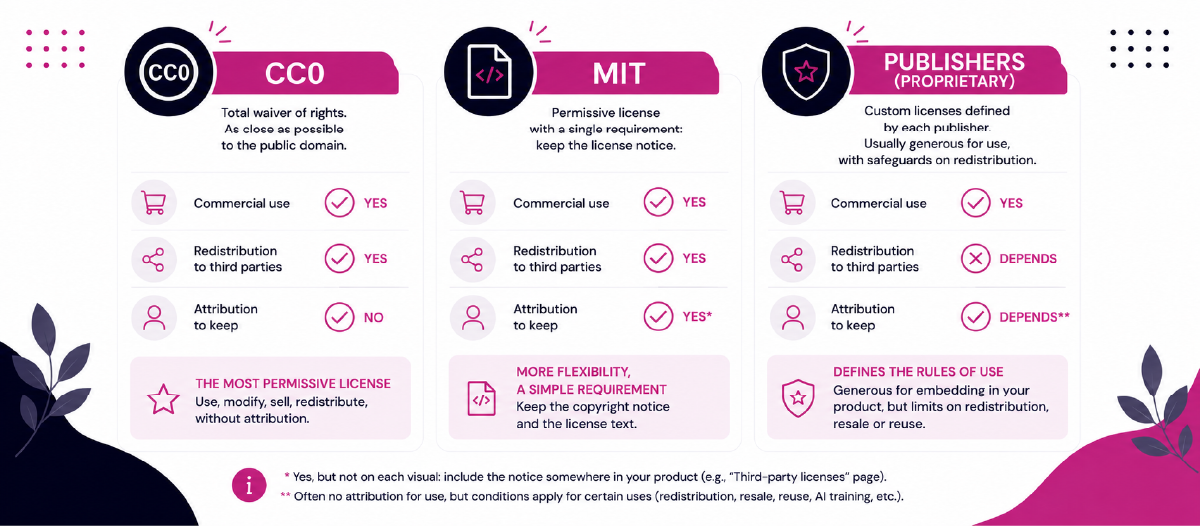
Comparison: three families, one same commercial use
Here are the three families side by side, on the questions that really decide. The information comes from the official license pages, to be checked on each site as they can change.
| License family | Commercial use | Redistribution to a third party | Mandatory notice | Illustration example |
|---|---|---|---|---|
| CC0 (waiver) | ✅ Yes | ✅ Yes | ✅ None | Open Peeps, Open Doodles |
| MIT / permissive | ✅ Yes | ✅ Yes | ⚠️ Keep the license notice | Illlustrations.co |
| Custom license (publisher) | ✅ Yes (dressing up) | ❌ Often excluded without consent | Varies by publisher | unDraw, DrawKit |
Sources: official license pages of each resource, captured in July 2026. Licenses can change: it happened to unDraw. Always check the /license page before integrating an asset.
The special case of fonts
Fonts have their own world of licenses, separate from that of images, and the trap there is even sharper. Because one sentence comes up often: "I bought it, so I can". Yet buying a font doesn't give you every right at once.
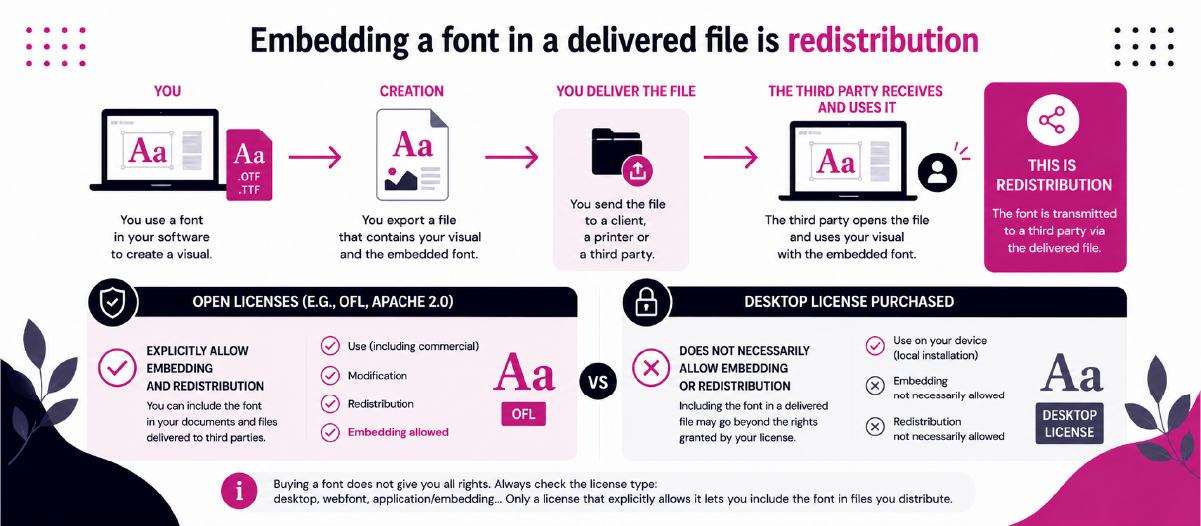
Foundries sell separate rights. A desktop license lets you install the font to design on your workstation. A webfont license lets you serve it on a website. An app or embedding license lets you include it in a file you distribute. These are three distinct tiers. Exporting a visual that embeds the outlines of a font bought under a desktop license alone can therefore exceed what you paid for, exactly like the illustration handed to a third party.
Against this, open font licenses remove the ambiguity. The reference is the SIL Open Font License, or OFL: it allows use including commercial, modification, redistribution and, above all, embedding the font in your documents and files7. Three simple rules come with it: fonts cannot be sold on their own, a modified version cannot reuse a name reserved by the author, and a redistributed font must travel bundled with something else, not be sold standalone. Nothing that gets in your way for a visual. Some fonts are also published under the Apache 2.0 license, just as permissive and compatible with embedding8.
Three traps to know
Once the families are understood, three classic mistakes remain, the ones that trip up even seasoned professionals.
Outdated listicles. Many articles still list a given illustration library as "CC0" on the strength of an old post. Sometimes that's false today: unDraw, long cited as public domain, tightened its license5. Never rely on a secondhand list. Open the source's own /license page, it's the only document that counts.
Trademarks and the right to one's image. CC0 waives copyright, but not trademarks or people's right to their image1. A "free" illustration can contain a logo, a recognizable product silhouette or a face: those elements remain protected by other rights the license does not lift. Set aside assets that embed a trademark if you're not sure.
Untracked provenance. As soon as you mix several sources, keep a record of each asset's license. Prefer first-hand sources (the author's own site) over free-upload aggregators, where a file can be mislabeled by whoever uploaded it. The day a license is challenged, knowing where each element came from protects you.
Choose deliberately, and keep a file that's truly yours
It all comes down to one question, the same for illustrations and for fonts: does the license cover the exact use I'm making of it, redistribution included? Answer that, and you'll never be caught off guard.
It's also the principle that guides the resources built into Ask N Pic. The file you export is yours: we transfer its rights to you the moment it's generated. For that promise to hold all the way through, we only keep illustrations and fonts whose license allows embedding and redistribution in your export, open licenses such as CC0, MIT or OFL. In other words, we never hand you an asset you wouldn't be allowed to keep. The details of the resources and their licenses are documented on our credits & licenses page.
And when a creator chooses a license that restricts redistribution, we respect that choice rather than working around it. A sovereign tool protects the data of its users; it also protects the work of the creators whose resources it relies on. Ask N Pic generates graphic compositions editable in your browser, hosted in Europe, that you walk away from with a clean file, without a legal grey zone. Beta sign-ups are open, places are limited.
Frequently asked questions
Illustration and font licenses: what you ask
Does "free for commercial use" mean I can do anything?
No. "Free for commercial use" generally covers dressing up your own materials: your website, your brochures, your posts, your visuals. It says nothing about the right to redistribute the asset to a third party, for example when your client walks away with the illustration embedded in the file you deliver. That right depends on the specific license, and many so-called free licenses exclude it. The right question is never "is it free?" but "does the license cover the exact use I'm making of it?".
What is the difference between a CC0 and an MIT license?
CC0 is a waiver: the author gives up their rights and places the work as close to the public domain as possible1. No notice to keep, no obligation. The MIT license grants very broad freedom (use, modification, redistribution, including commercial) but requires keeping the copyright notice and the license text in redistributed copies3. In practice, with CC0 you owe no one anything; with MIT you keep the author's notice somewhere in your product.
Can I use a Google Fonts typeface in a commercial project?
Almost always, yes, but "Google Fonts" is not a license: it's a library. Each font is published there under its own license, most often the SIL Open Font License (OFL), sometimes Apache 2.09. These licenses allow commercial use and embedding the font in your files. The good habit is still to check the license of the specific family you use, rather than assuming "it's on Google Fonts, so I can do anything".
I bought a font: can I embed it in the files I deliver to my clients?
Not necessarily. Foundries sell separate rights: a "desktop" license lets you install the font to design, a "webfont" license lets you serve it on a website, an "app" or "embedding" license lets you include it in a distributed file. Exporting a visual that embeds the outlines of a font bought under a desktop license alone can exceed what you paid for. Check the embedding tier, or choose a font under an open license (OFL)7, which explicitly allows embedding in your files.
How does Ask N Pic choose the illustrations and fonts it makes available?
On a single criterion: the file you export must be genuinely yours. We only keep resources whose license allows embedding and redistribution in your export (open licenses such as CC0, MIT or OFL). In other words, we never hand you an asset you wouldn't be allowed to keep. And when a creator chooses a license that restricts redistribution, we respect that choice rather than working around it.
Visuals that are truly yours
Ask N Pic generates graphic compositions editable in your browser, with illustrations and fonts under open licenses: the file you export is yours, without a legal grey zone. Hosted in Europe. Beta sign-ups are open, places are limited.
Join the beta